
Aysén in depth · Part 12 ·
Whales, orcas and dolphins in Aysén:
what you will actually see
Jaroslav Sokol · Aysén region, Chile · 11 min read
The short answer
In the fjords of Aysén proper (Puyuhuapi, Jacaf, Moraleda) the commonest cetacean is Peale's dolphin. A dedicated survey in 2009 recorded 86 groups of five species in 194 hours on the water: 55 groups of Peale's dolphins, 17 groups of Chilean dolphins, 8 groups of porpoises, 4 groups of blue whales and not a single orca or humpback whale. For blue whales you travel further north, to the Gulf of Corcovado, where the 2012 estimate was 570 to 762 animals. The season runs from December to May, with the core from January to April. Chilean law sets a minimum distance of 300 metres from a blue whale.
Geography first, because even the tour operators confuse it
The Gulf of Corcovado lies at roughly 43° south, between the island of Chiloé and the mainland, and it straddles the boundary between the Los Lagos and Aysén regions. The Aysén Fjord is something else entirely: an inlet at about 45°25′, with Puerto Chacabuco at its head.
Almost all the famous material on blue whales concerns the Chiloé-Corcovado area, meaning the northern edge of Aysén and the south of Los Lagos. The fjords of Aysén proper are by contrast dolphin territory, not whale territory.
Confusing these two places is the commonest error in travel writing about this part of Chile. If somebody promises you blue whales "in the Aysén fjord", keep asking questions.
What is actually there: the only proper survey of Aysén
From 24 February to 26 March 2009 a dedicated survey ran from small boats: 23 days, 194 hours on the water, covering the Puyuhuapi Fjord (half of the total effort), the Jacaf Channel and the Moraleda Channel, between 44° and 46° south. The result was 86 groups of five species.
Peale's dolphin (Lagenorhynchus australis), 55 groups, 330 individuals, with a typical group of around ten animals. That is 64% of all the groups recorded. This is the species that comes over to the boat and rides the bow wave.
Chilean dolphin (Cephalorhynchus eutropia), 17 groups, 92 individuals, usually in pairs. Shy, and it keeps to the shore.
Burmeister's porpoise, 8 groups, 26 individuals. Inconspicuous, and easy to overlook.
Blue whale, 4 groups, 23 individuals.
Bottlenose dolphin, 2 groups but 200 individuals, because a typical group here held around a hundred animals.
And here is what did not appear once in those 194 hours: the orca, the humpback whale and Commerson's dolphin.
Blue whales: why Corcovado is an address of world importance
In 2003 seven aerial and boat surveys in the Chiloé-Corcovado area recorded 153 blue whales in 47 groups, including at least eleven mother and calf pairs. The authors described it as probably the most important known feeding and nursing ground for blue whales in the southern hemisphere. The southern hemisphere population had by then been cut to under three per cent of its original size.
A later estimate for 2012, using the POPAN method, gives 570 to 762 animals using the waters off Chiloé seasonally. The surveys ran from 2004 to 2012, always from late January to April. Abundance peaked in 2009 and it swings widely between years, probably with the density of prey rather than with any growth in the population itself.
A 2026 study in the journal Marine Mammal Science, led by Bárbara Galletti of the Centro de Conservación Cetacea, went through photo identification records from 1992 to 2019 across Chile, Peru, Ecuador and Costa Rica. It found 758 identified blue whales between 40° and 44° south, and a 43% annual return rate to the feeding grounds of southern Chile. The longest gap between two sightings of the same animal was seventeen years. One individual covered more than 5,200 kilometres between the Galápagos and the Gulf of Corcovado, and a female named Valentina was photographed eleven times in ten years.
These are not anonymous giants, then: Chilean researchers know them one by one.
The protected areas that exist here because of the whales
The Tictoc-Golfo Corcovado Marine Park was declared on 8 July 2022 and covers 101,900 hectares. It sits exactly where the Los Lagos and Aysén regions meet. It is Chile's eleventh marine park, the largest in the country's continental marine zone and the only one in the Chiloense ecoregion, where less than 0.1% of the marine area had been protected before.
The Pitipalena-Añihué Marine and Coastal Protected Area, in the commune of Cisnes, was created by a decree of 18 February 2014 and covers 23,735.64 hectares. It explicitly protects the blue whale, the bottlenose dolphin, the Chilean dolphin and Peale's dolphin, thirteen species of marine mammal in all. It is a pioneering example of a territory the state manages jointly with the local community.
Melimoyu National Park was declared on 9 August 2018. It is mostly terrestrial but coastal, and one of the reasons for creating it was to make it easier to protect whales and dolphins in the adjacent marine areas. Much of it can only be reached by sea.
A note on terminology: no formally declared "Melimoyu marine reserve" exists. If you come across the phrase, it is most likely shorthand for the group of protected areas around Melimoyu.
Golfo de Penas 2015: the largest mass mortality of baleen whales on record
Between February and April 2015, at least 343 dead whales, mostly sei whales, were found in the Golfo de Penas and the surrounding waters of Chilean Patagonia. A boat survey in April 2015 found 35 freshly dead animals and twelve skeletons, and an aerial survey in June mapped 305 carcasses.
The cause was a toxic algal bloom producing paralytic shellfish toxins, which were confirmed both in mussels collected locally and in the stomach contents of the whales. The event took place during a developing El Niño.
Why this counts as a record: the largest mass mortality of baleen whales documented before it involved fourteen humpback whales in 1987, so 343 is more than twenty four times that number.
A more recent review of Chilean strandings puts the summer of 2015 at 402 sei whales, and the whole 2015 to 2020 period at 426, of which 388 deaths are attributed to biotoxin poisoning. The figure of 343 is what the original team managed to verify in the field.
The Golfo de Penas is a recognised important marine mammal area of 11,253 km², where up to six hundred sei whales have been documented. To this day it has no protected status.
Orcas: why nobody can promise you one
Over eleven years, from 2001 to 2012, 119 new sightings of killer whales were recorded across the whole of Chilean Patagonia. Most of them come from the Comau fjord (29) and from the Francisco Coloane marine park in Magallanes (14).
Group sizes ranged from lone animals to gatherings of sixty, but the average was 4.2 animals and most encounters involved between one and fifteen individuals.
The first photo identification catalogue holds 49 individuals, told apart by the dorsal fin and the saddle patch. Only seven of them have ever been seen again, which suggests either a large population or several separate subpopulations. Nobody knows the size of that population. The International Union for Conservation of Nature lists the orca as data deficient.
Hunting was documented in fourteen of the sightings: South American sea lions, South American fur seals, penguins, gulls, fish taken from fishing boats, and one filmed attack on a sei whale.
The realistic summary is that orcas in the fjords of Aysén are rare and unpredictable, and the dedicated survey described above did not record a single one in 194 hours.
The Chilean dolphin: the only species endemic to Chile
The Chilean dolphin (Cephalorhynchus eutropia, in Spanish delfín chileno or tonina negra) is the only cetacean endemic to Chile. It occurs from Concón near Valparaíso (33°S) to Seno Grandi on Navarino Island (55°15′S), mainly south of Valdivia.
It is one of the smallest dolphins in the world: a maximum length of 167 centimetres and a maximum weight of 63 kilograms. Stocky, rounded and grey, with a white throat and a dark stripe running from the blowhole to the eye.
A detail for anyone who enjoys bureaucracy: the Chilean national classification rates it differently from region to region. From Los Lagos northwards it is listed as vulnerable (VU), and from Aysén southwards as near threatened (NT). The International Union for Conservation of Nature lists it as near threatened.
Nobody has ever counted it nationwide. The only detailed abundance study found 59 individuals in an area of roughly 275 km² off southern Chiloé. It lives in resident groups of forty to a hundred and twenty animals which do not mix at all between neighbouring areas, keeping to shallows under thirty metres, within a kilometre of the shore and around river mouths. Unlike Peale's dolphins, it steers clear of boats.
The thirty year ban on hunting marine mammals, dating from 1995, expired in 2025 and was renewed in November 2025 for another thirty years, covering roughly seventy species.
The threats the brochures leave out
Ship strikes. Of 226 stranded whales recorded in Chile between 1972 and 2023, 63 cases (28%) can be attributed to a collision with a vessel. Since 2013 ships in Chilean waters have killed an average of five large whales a year, which gives Chile the highest strike rate in the world for the 2013 to 2023 period, ahead of Sri Lanka and the west coast of the United States. And 55% of the strikes fall between January and May, exactly the season when people come here to watch whales.
Boat traffic around the farms. A study that tracked fifteen blue whales by satellite showed that their priority areas include the northern Moraleda Channel, which is Aysén. In that same space 602 to 729 aquaculture vessels move every day, in places as many as 78 boats in a single 8 × 8 kilometre cell. That is an order of magnitude more than any other fleet: small scale fishing 37 to 76 boats a day, transport 6 to 57, industrial fishing 1 to 13.
Entanglement in nets. Between 2015 and 2020, 791 entangled animals were recorded in Chile in 253 events. Of all the Chilean regions, the one with the most entangled individuals in that period was Aysén.
When to go, and what the rules are
Season: December to May, with the core from January to April. The research cruises for blue whales in Corcovado run from late January to April. February and March are the best compromise, and that is the window in which the Aysén survey described above took place.
What you will realistically see in the fjords of Aysén: Peale's dolphins, often, in groups of around ten, coming right up to the boat. Then Chilean dolphins in pairs near the shore, shy of you, and porpoises that are easy to miss altogether. A blue whale is possible but irregular. Orcas and humpbacks are not something to promise yourself.
For blue whales you have to go north, to the Gulf of Corcovado. The realistic departure points are Melinka in the Guaitecas archipelago and Quellón on Chiloé.
The law. In 2008 Chile declared the whole of its two hundred mile exclusive economic zone a whale sanctuary. Regulations from 2011 set a minimum distance of 300 metres for the blue whale, 100 metres for other large whales and 50 metres for small cetaceans. The southern right whale may only be watched from the shore. Jet skis are banned, as are feeding and forced contact.
Let me put it plainly: a boat that gets you close to a blue whale is breaking Chilean law. An honest operator will leave you three hundred metres away and hand you a pair of binoculars.
Frequently asked questions
Can you see whales in Aysén?
In the fjords of Aysén proper only exceptionally, and the dedicated survey recorded four groups of blue whales in 194 hours on the water. What you will normally see there are Peale's dolphins, Chilean dolphins and porpoises. For blue whales people travel further north, to the Gulf of Corcovado.
When is the best time for whale watching in Chilean Patagonia?
December to May, with the core from January to April. February and March tend to be the best compromise between the number of animals and the weather.
Are there orcas in Chilean Patagonia?
There are, but they are rare and unpredictable. Over eleven years 119 sightings were recorded across the whole of Chilean Patagonia, and the average group held 4.2 animals. The size of the population is not known, and the International Union for Conservation of Nature lists the orca as data deficient.
How close to a whale are you allowed to go?
Chilean regulations from 2011 require a minimum distance of 300 metres from a blue whale, 100 metres from other large whales and 50 metres from small cetaceans. The southern right whale may only be watched from the shore.
What is the Chilean dolphin?
The only cetacean endemic to Chile. It measures 167 centimetres at most and weighs up to 63 kilograms, which puts it among the smallest dolphins in the world. It lives in resident groups of 40 to 120 animals that do not mix between neighbouring fjords, and unlike Peale's dolphins it steers clear of boats.
Sources
- Zamorano-Abramson, Gibbons & Capella, Anales Instituto Patagonia (2010): survey of cetaceans in Aysén
- Hucke-Gaete et al., Proc. R. Soc. B (2004): discovery of the blue whale feeding ground off Chiloé
- Galletti Vernazzani et al., PLoS ONE (2017): abundance of blue whales
- Häussermann et al., PeerJ (2017): the mass mortality in the Golfo de Penas
- Capella, Häussermann et al. (2013): killer whales in Chilean Patagonia
- Toro et al., Marine Policy (2025): ship strikes on whales off Chile
- Bedriñana-Romano et al., Scientific Reports (2021): overlap between blue whales and shipping
- IWC Whale Watching Handbook: the rules for Chile
- Pew Charitable Trusts (2022): the Tictoc-Golfo Corcovado marine park
Where sources disagree, the range and the source are given. Figures are current as of August 2026.
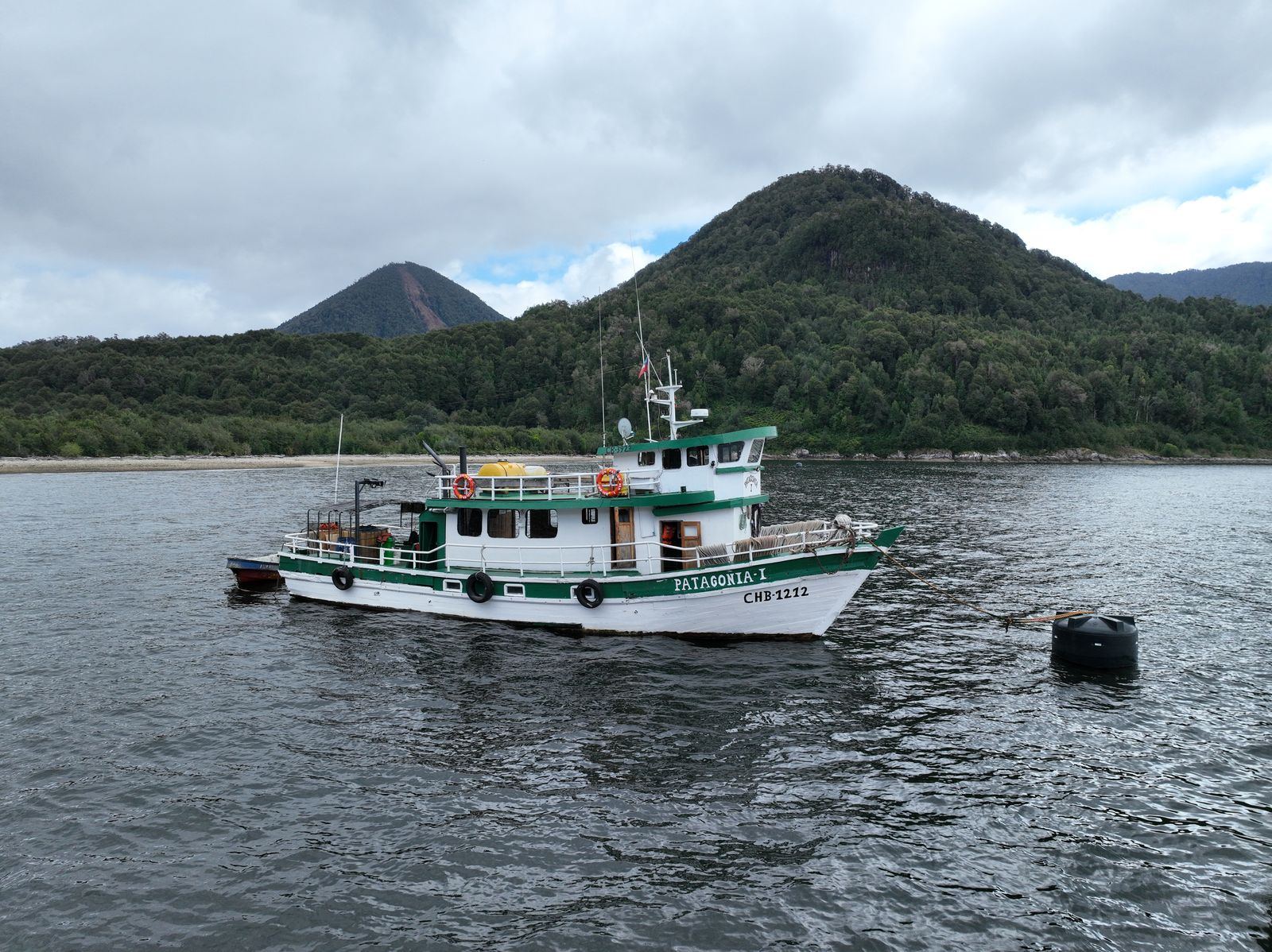
We spend four days aboard the Patagonia - wildlife watching straight from the deck.
Expedition programWritten from Aysén
What didn't fit in the article
Every so often I send an email about what is happening in Aysén, new articles like this one, and chapters of Václav Nový's memoirs, which I translate from the Spanish. When places open on an expedition, I'll mention it in one line. Nothing else.
Two emails a month at most. One-click unsubscribe. Your address is never shared, privacy policy.
All articles
Patagonia from scratch · series
Series part 1 · The Aysén region: a province younger than Czechoslovakia24 Aug 2026Aysén in depth
Darwin in the Chonos Archipelago: what he wrote in his diary29 Sep 2026 Whales, orcas and dolphins in Aysén: what you will actually seeyou are here The Ring of Fire in Aysén: volcanoes, a fault and a fifty-metre wave14 Sep 2026 24 min listenGuides
Aysén or Torres del Paine? A comparison for the undecided5 Oct 2026 Patagonia: Chile or Argentina? How to choose4 Sep 2026 7 min listen What a Trip to Patagonia Really Costs26 Aug 2026 8 min listen Carretera Austral: What Driving It Actually Takes21 Aug 2026 7 min listen When to Fly to Patagonia: Months, Light and Flights17 Aug 2026 5 min listen Patagonia Without the Crowds: Where to Go Instead7 Aug 2026 8 min listen Chile's Marble Caves: How to Get There29 Jul 2026 5 min listen Cerro Castillo: The Trek They Call the New Torres del Paine22 Jul 2026 7 min listenBefore you book
Patagonia Tour or Small Expedition?22 Aug 2026Expedition journal
San Rafael Glacier: The Day the Glacier Spoke5 Aug 2026 2 min listen