
Memorias de un Refugiado · Chapter 4 ·
Chapter 4:
Grandfather
Václav Nový · translated from the Spanish original by Jaroslav Sokol · 7 min read
This chapter is different from the ones before it. There is no Hitler in it, no eviction, nobody is running anywhere. It is the brightest part of the whole book, and Václav opened it with a sentence that sent me straight back to my own childhood at my grandmother's: “Perhaps the happiest period of my life was the time I spent at my grandfather's.”
A boy who had just lost his house had one place where nothing had changed. Two hours by train from Písek.
What follows is an excerpt from Memorias de un Refugiado, which I am translating from the Spanish original. This is not fiction, it is an autobiography, the true story of Václav Nový. The full chapter appears in the book.
My Life in Europe, Chapter 4: Grandfather
Looking back today, perhaps the happiest period of my life was the time I spent at my grandfather's, my mother's father.
Grandfather lived in a small town about two hours by train from the city. That train fascinated me: it had only two carriages, and the first was not a steam locomotive like most, but a railcar. A great novelty to me, because I knew and loved steam locomotives. They seemed alive. I could stand on the platform for hours watching those marvels made by man.
The farmstead behind the wide gates
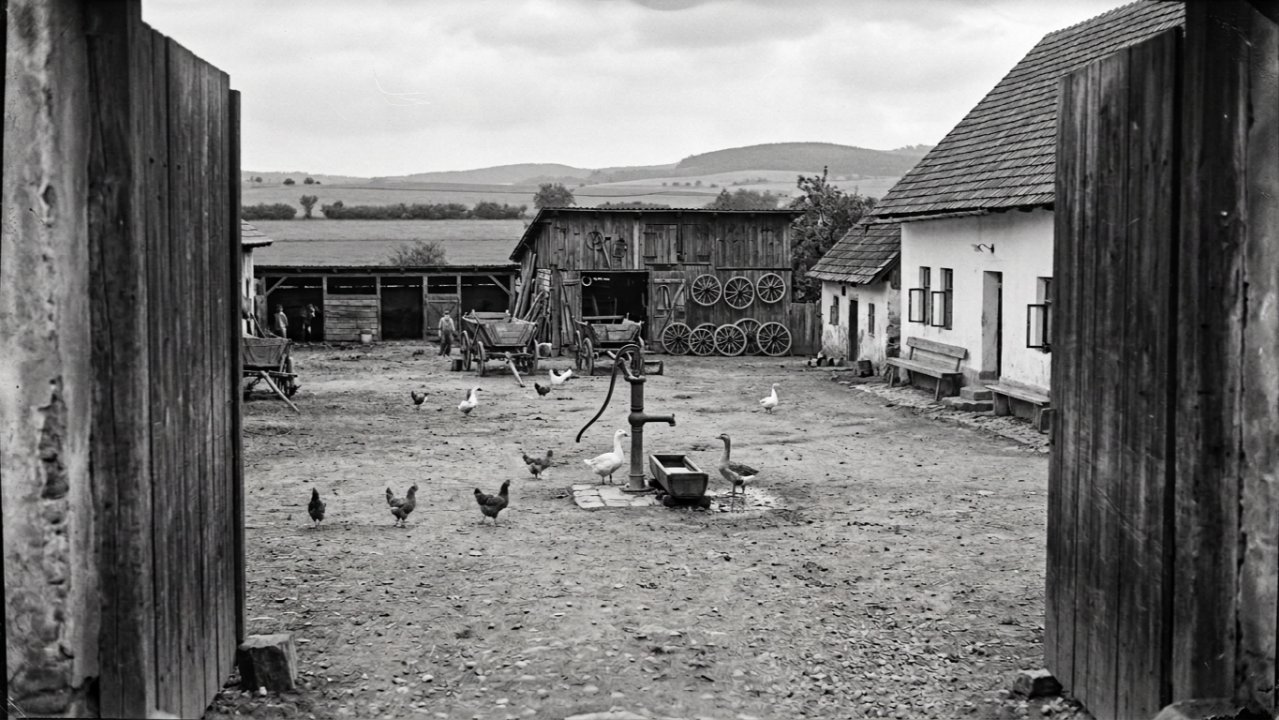
But back to my grandfather. He lived in a little town with a square and houses along one side, and below them the fields began. Grandfather had an entrance with wide gates. You came into a spacious yard: on one side the main building, right by the gates a small house for my grandparents, and at the back a wheelwright's workshop. In his younger days my grandfather had made carts for the farms. He made wheels too, and that was the most interesting part, because he turned everything himself. When a wheel was finished, an iron tyre was heated red-hot, drawn over the felloes, and as it cooled it never came off again.
By then he already had a master craftsman in the workshop who went on making the carts and wheels. Grandfather went there every day. He never interfered with the work; he only watched. Most likely he was remembering the days when he was the master himself.
At the back of the yard were the stables. First the horses, behind them the cows, and then the pigs. Grandfather loved the horses best of all, and so did my uncle. They took turns currying and stroking them. Flocks of hens, turkeys, ducks and geese wandered about the yard, so there was never any shortage of movement.
In the middle of the yard stood a large hand pump. That was where the whole household washed every morning.
We ate at my uncle's, at a big table. He sat at the head, my grandparents around him, and everyone who worked on the farm. What I remember best are the bowls of steaming potatoes and the large jugs of milk. The butter came in pieces of about a kilo, three or four such loaves on the table. Everyone helped himself, added butter to taste, and there was plenty of milk.
The oven you could sleep on
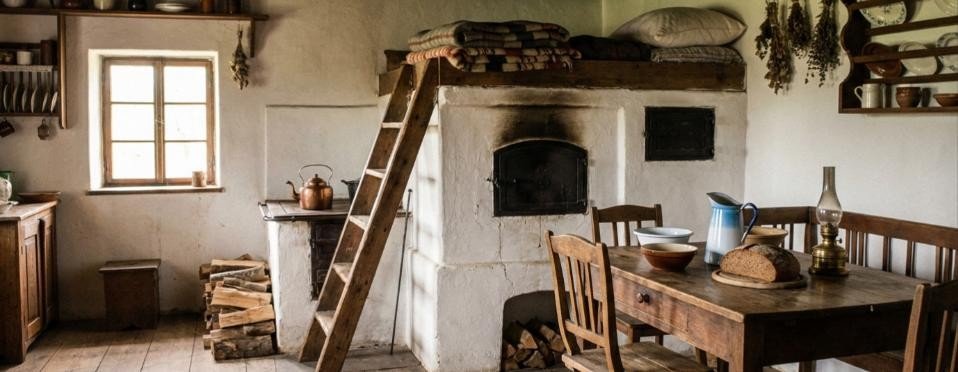
In my grandfather's little house there was a brick oven, about three metres long and two wide, with two iron doors. Bread was baked in it every four or five days. The loaves were around forty centimetres across, round and dark. A slice with lard was more than you could finish; it was enormous.
And my grandfather and I had one favourite place: up on top of that oven. We would climb up and he would tell me what he had lived through and teach me all sorts of things. Sometimes we fell asleep up there.
What my grandfather told me up on that oven, why the outhouse was moved from its place every autumn, and my grandfather's philosophy, which would sound strange today, but may be truer than it was then, all of that is in the book.
My take
One sentence from that chapter won't leave me. Grandfather went into his own workshop every day, but he never interfered with the work. He only watched.
He handed the craft over to the master and then stayed out of his way. No “I'd have done it differently.” He came, he watched, he left. That is a discipline most founders can't manage today, and I admit I'm still learning it myself, with my son.
Of all those holidays Václav doesn't remember toys or presents. He remembers the warmth of the bricks and a grandfather who talked. The most valuable things he was ever given cost nothing.
I write this and think about my son. On the boat he doesn't learn knots from me because I lecture him about them. He learns them because he sits beside me. Václav's grandfather knew it back then: experience isn't handed over by explanation, but by presence.
Václav's oven stood at the end of a yard in a Czech market town. Mine takes the form of a deck on the Jesenice reservoir.
About the book
Memorias de un Refugiado is being published in Czech for the first time by Aysén Fjord Editions. Chapters appear gradually, first in the Sokol v Patagonii newsletter on LinkedIn, then here. All proceeds go to the author's family in Chile.
Next: Chapter 5: My Father and the War. One day the Nazis came and gave his father a choice. It was the last chapter in which Václav saw him.
The next chapter by email
Have the next part sent to you
Chapters of Memorias de un Refugiado come out every two weeks. I'll write when the next one is up, and now and then add something from Aysén, where the book was written. Nothing else.
Two emails a month at most. One-click unsubscribe. Your address is never shared, privacy policy.